Composite Workforce: The spine of an AI-native company

Companies that bring in AI agents usually report savings in the first year. Those savings can be lost from the second year if the work, the people and the company’s knowledge are not planned at the same time as the agents. This article describes that problem and the Composite Workforce EnterpriseTM, the operating model that works as the spine of an AI-native company.
A Typical First Year with AI Agents
Consider a mid-sized telecom company at its year-end review. The company is an illustration, but it is based on a pattern that we see often in our work.
The AI programme reports three results. Three thousand employees have completed an AI course. The enterprise billing operations team in business support systems (BSS), which once had 50 people, now runs with 30 people and a set of AI agents. Two new agents in the same process do work that once needed a senior analyst.
An AI agent is software that can carry out a task by itself, within limits that a person sets. In this company, agents check the bills of enterprise customers against their contracts, analyse billing differences and prepare the monthly reports.
The results are good. During the review, however, the CHRO points out that new graduates used to learn the business in that operations team, and asks and asks where they will learn it now.
The CFO, who has booked the saving, asks a second question. If some of the 20 have to be hired back, what will they cost, and what happens to revenue and to enterprise customers while an agent is getting their bills wrong? The CEO asks a third: will billing run as well in year three as it does today?
The leadership team has not planned for any of this.
Why AI Savings Shrink After the First Year
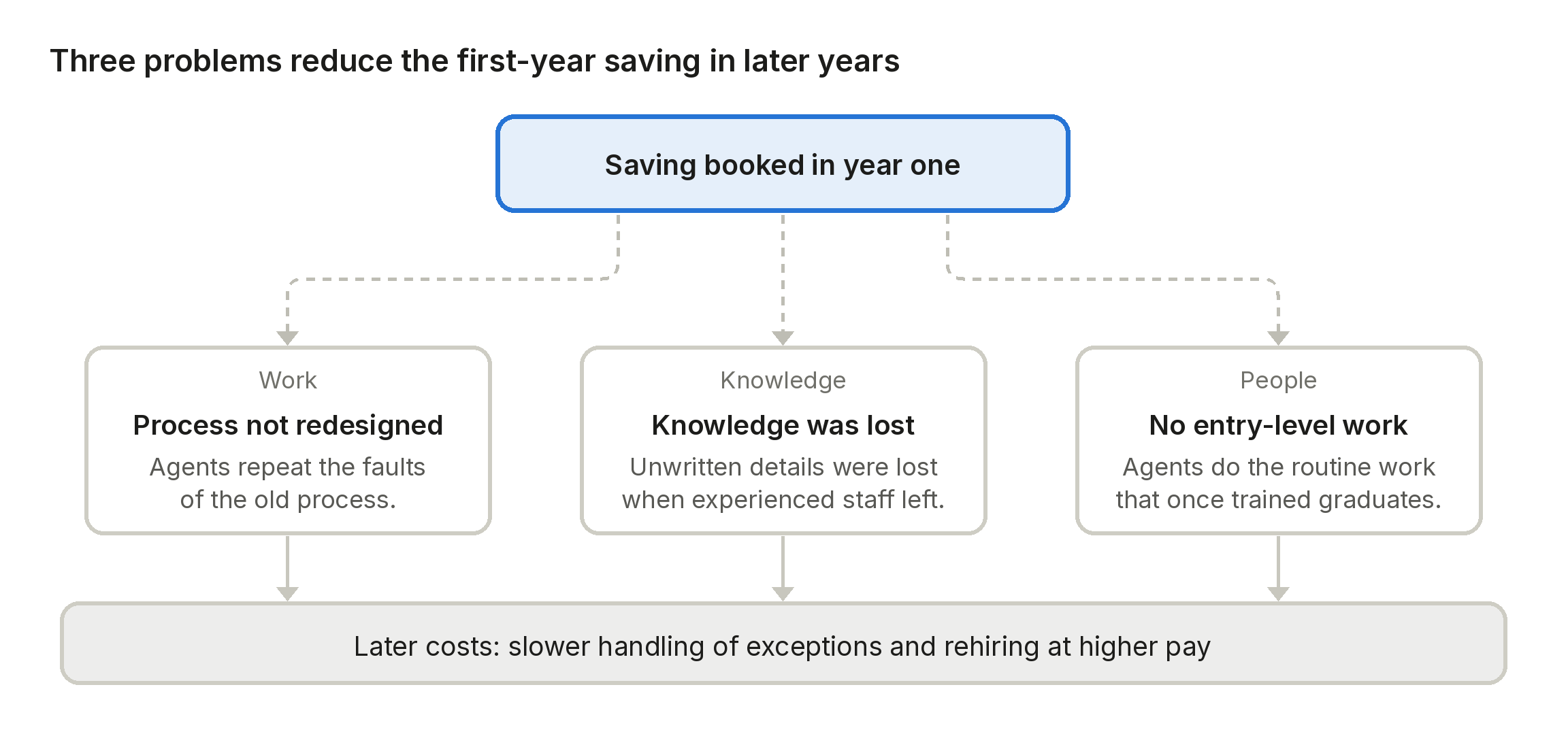
Over the next few quarters, the company runs into problems in three areas: its work, its knowledge and its people.
The first problem concerns the work itself. The agents were added to the existing process, and the process was not redesigned. For example, one agent re-applies the same negotiated discounts in every billing cycle, because the order form at the start of the process was never corrected. The process now costs less to run, but it has the same faults as before.
The second problem concerns knowledge. Every company depends on details that only its own employees know, such as which customer pays on different terms, or what to do when the system shows a wrong figure. Much of this knowledge was never written down. When 20 people left the team, most of it was lost.
The third problem concerns people. Graduates used to join the operations team and do the routine work, which taught them how the company earns its money. The agents now do the routine work, so the company no longer has entry-level work for graduates. It had also expected its future managers to come from that team.
By the second year, these problems cost the company money. Unusual cases take longer to resolve because few people know how to handle them, billing errors reach customers uncorrected, and the company has to rehire experienced staff at higher pay. As a result, it loses much of the saving it made in the first year.
Evidence From Real Companies
The public record shows that this risk is real.
In August 2025, the Commonwealth Bank of Australia reversed a decision to cut 45 customer service jobs after it had handed the work to an AI voice bot. The bank said that its first assessment had not considered all the relevant factors, and that “this error meant the roles were not redundant” (ACS Information Age).
In September 2026, the research firm Gartner predicted that by 2029, three in ten workers who are laid off and replaced by AI will have to be rehired, often at a higher cost (Gartner). Gartner’s reasons include the loss of future talent and the loss of institutional knowledge, which are two of the three problems described above. In October, Gartner linked the forecast to planning. In its survey of 297 heads of HR, only 19% of organisations had workforce planning that takes account of how AI is changing the work (Gartner, 28 October 2026).
The rehiring has already begun. In July 2026, the recruitment firm Robert Half found that 32% of US hiring managers whose organisations had cut roles because of AI later brought those roles back. Of these, 40% said the roles needed institutional knowledge or context that AI could not replace. In the same summer, the assessment firm SHL found that 19.1% of US workers replaced by AI had been asked to return, and that about half of such workers would want a substantial pay rise before returning. SHL calls this AI Rebounding (Fortune).
Why AI Agents Take Over Tasks, Not Whole Roles
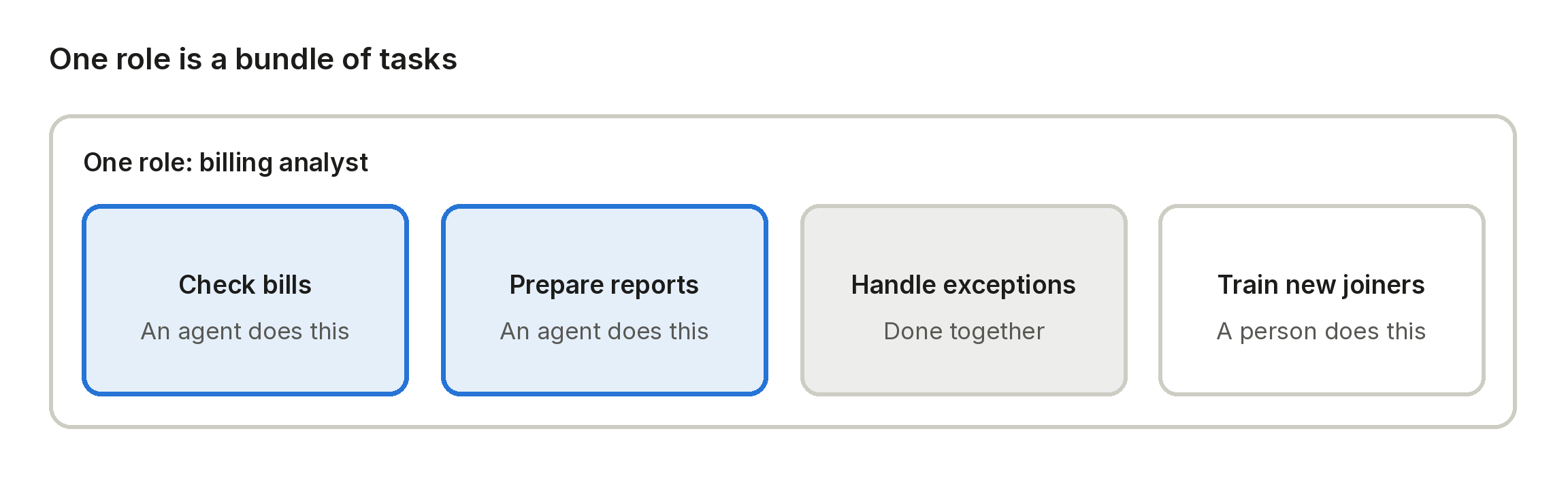
The cause of these problems is a common mistake. The company treated each role as a single unit that an agent could either replace or not replace.
In practice, a role consists of many separate tasks. A billing analyst checks bills against contracts, prepares reports, handles unusual cases, which are usually called exceptions, and trains new joiners. Agents can do some of these tasks alone and can share others with a person, but some tasks still need a person’s judgment. When the company removed whole roles, it also removed the people who did those tasks.
What the Composite Workforce EnterpriseTM is
The spine is a useful analogy. In the human body, the spine holds the body upright and allows its parts to move together.
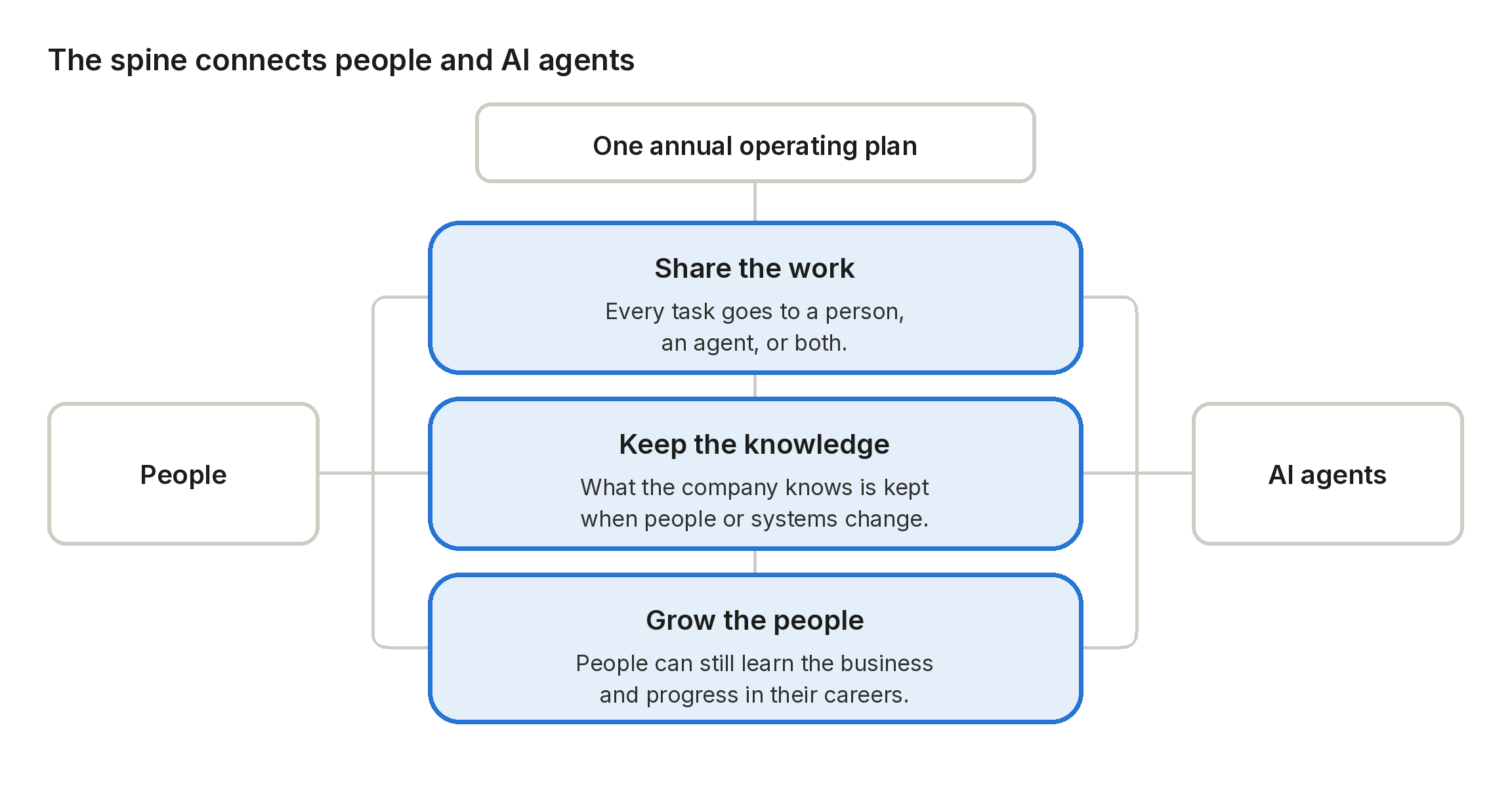
A company in which people and AI agents work side by side needs a structure that does the same: one that holds its work, its people and its knowledge together, so that a change in one is matched in the other two. At People Equation, we call this the Composite Workforce EnterpriseTM: a company whose workforce is composed of people and AI agents, and which shares the work between them deliberately. It has three parts, which together form the spine, and each part addresses one of the three problems described above.
- Share the work. Every task is given to a person, to an agent, or to both, and a named person is responsible for each decision.
- Keep the knowledge. What the company knows is recorded and kept up to date, so that it is not lost when a person leaves or a system changes.
- Grow the people. Roles, careers and pay are redesigned, so that people can still learn the business and progress in their careers.
The three parts are planned together in the annual operating plan. This is the plan in which a company sets its revenue, costs, investments and headcount for the coming year. In a Composite Workforce EnterpriseTM, the same plan carries the other side of the decision: the framework for adopting AI, a view of the processes it will change, a workforce plan that marks the points at which roles change, entry positions included, and the process and current state for building the company’s institutional memory. The leaders of finance, people, technology and operations prepare the plan jointly, so that all three parts are funded together.
How the Same Company Would Work as a Composite Workforce EnterpriseTM
Suppose the same company had used this model from the start.
Before any role changes, the enterprise billing team lists its tasks and decides who should do each one. The order form is corrected at the start of the process, so that agents no longer need to re-apply negotiated discounts in every billing cycle.
The knowledge of the experienced staff is recorded in one shared place that both people and agents use. Each time someone resolves a new exception, the answer is added to it.
Graduates still join the team. They learn the business by reviewing the agents’ work and by handling exceptions.
The company uses the same agents and makes the same saving in the first year. The difference is that the saving is still in place in the third year, because the company changed its roles, its process and its record of knowledge at the same time as it introduced the agents. Becoming an AI-native company is difficult, but the risks described in this article are known in advance and can be planned for. A company does not need to change everything at once. It can apply this model to one process at a time.
What Comes Next in This Series
This article is the first in a series on the Composite Workforce EnterpriseTM. Each of the next three articles explains one part of the model.
- Share the work: how to decide which tasks go to people and which go to AI agents, where to start, and how the annual operating plan carries the decision.
- Keep the knowledge: how a company records what it knows, and why that record is difficult for a competitor to copy.
- Grow the people: where new joiners learn the business, how careers and pay change, and how a workforce plan is drawn up when agents do part of the work.